Showing posts with label Miso. Show all posts

Tuesday, August 31, 2010

Aji no Kura 味の蔵

Some restaurants actually come to Sapporo in their attempts in food stardom. In particular instances, this creates a sort of push in the Ramen scene, as influence from other areas of Japan can be helpful in boosting the concept of ramen.

In comes Aji no Kura, 味の蔵, The Taste Shack.

Aji no Kura is a recent restaurant being heavily, I mean heavily, advertised on Tabelog. Every time you search for Ramen in Hokkaido, this restaurant pops up in the sponsored area. It's also seemingly popular, usually a few people out the door waiting, and it mantains a 3.5/5 rating online. If anything, the first reason to the shop's popularity just comes from their hours.

Open 24/7.

Ramen tends to be well associated with the late night dwellers of Japan, the drunk masses hungry loners looking to fill up after their alcohol fill up, and a 24 hour spot in downtown drinking central Susukino pretty much can't be beat.

There's a couple issues pushing folks back however. The initial one is that this shop isn't actually Sapporo-grounded at all, it began in Shinjuku, a ward of Tokyo, and to many Sapporo ramen purists, this is a negative characteristic. Can we truly call it Sapporo ramen if it didn't start in Sapporo?

Well... why not? With modern technology allowing transportation of all sorts of agriculture, do the lines of what is genuinely Sapporo blend? Restaurants like this somewhat suggest that question.

Perhaps the reason the reason it doesn't scream Sapporo Ramen is because the menu attempts to replicate ramen from all over Japan, rather than focusing on one style. It feels like a shop importing ideas to Sapporo, rather than making new ones.

Well, we've heard the shop background so far. It's open all day and night, and has a pretty remarkable location.

How about the goods?

Aji no Kura is famous for their Pork Bone broth, a broth apparently simmered for more than 12 hours to extract as much rich, milky flavor as possible. They are not, however, famous for Miso, or really any particular style infact.

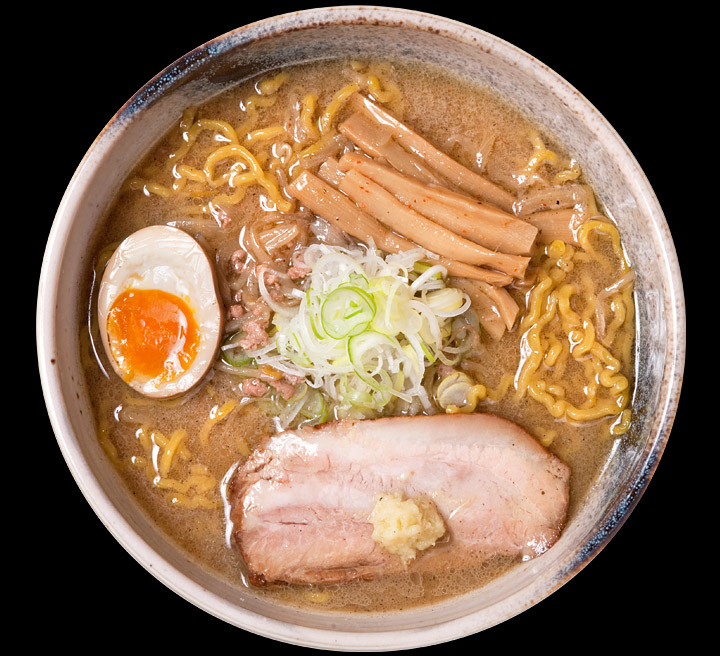
This shows quickly in the above miso dish. It's composed much like a Pork Bone soup, but the miso is put largely, if not completely on the back burner.

Furthermore, although you're able to pick one of two noodles, both of which are made by the company, they're both thin and fairly un-curly.

So on a basis, it doesn't really even share the miso characteristics Sapporo folk love. No thick noodles, no powerful miso flavor. It reminds me of Kyushu Ramen to be honest. Which is not a bad thing at all.
In fact the food is pretty dang good. As a Pork Bone soup, it's very tasty, a good balance of rich and light. Some garlic oil drizzled on top adds good complexity and character, and the noodles pair up well with the soup's characteristics (though I thought they were soft).

The shop also provides a laundry list of toppings you can freely add, including crushed by yourself garlic, stewed spicy vegetables, and pickled ginger, among others. This can at times be overwhelming, but at the same time, fun to customize a bowl.

If drunk at 3 am, this might be the closest option you have for that late night ramen fix. And you certainly wouldn't be disappointed.


View Larger Map

Aji no Kura
Open 24 hours a day, 7 days a week.

Links:
http://www.ramen-ajinokura.com/
http://r.tabelog.com/hokkaido/A0101/A010103/1026114/

Wednesday, August 11, 2010

麺屋彩未 Menya Saimi

Any entry in food about Sapporo cannot be without Menya Saimi, its popularity is... obscene to be perfectly honest.

Saimi is a miso ramen restaurant that opened only about 10 years ago in the "Ramen Warzone" known as the Toyohira district of Sapporo. They boomed immediately, and to put it bluntly, are the most popular miso ramen restaurant in all of Sapporo. They have souvenirs, amazing online ratings, even ramen you can purchase in the super market. Saimi is a great success, hands down.

This is particularly interesting when we take a look at the sign.


The sign says "Saimi, from Sumire"

Sumire?? This Sumire?? The legends??

Yes. Apparently the owner had worked in Sumire prior to making his own shop. You can assume then that he attempts to take a more modern approach to Miso, and in turn step away from some of the more old school variants.

The popularity of this restaurant is ridiculous. It has an astounding 4/5 on Tabelog, officially ranking it one of the highest ranked restaurants, yes restaurants, not just ramen shops, in Hokkaido.

So we've just blown past Sapporo. That's pretty noteworthy by any standard. Other rating websites agree, and Saimi is always at the very least mentioned in some form of guidebook.

This popularity shows; expect to wait anywhere for 15-30 minutes, as there is always a line. I personally went on a Sunday and waited 30 minutes.

Out of the door...


And through the shop

The shop is so popular that the train station nearby actually lists directions on which exit to take to more easily access the shop. Just as you get off the Misono stop on the blue line, you'll see the sign.

Critics rave about how it takes the deep flavor of Junsumi style, but without the heavy richness and lard cap, a balance between light and heavy, perfect composition. Homemade noodles and fresh ground ginger complete the dish. Honestly, everyone says good things about this place.

Which honestly worries me. Why are the only negative comments about the wait? Is there such a thing as over hype?

It's possible.


This is Saimi's legendary bowl. The top rated, undisputed loved Miso Ramen.

It's... well. It's really good. As expected. I can't pick anything wrong with it. Even the way it looks is lovely, bright green, pink, yellow. popping out. The noodles are thick and curly and cooked perfectly, two types of wonderfully cooked pork, with a subtle sting of ginger in the mellow, complex soup. A touch of sweet, not overly salty, just right. Portion is ample as well. It's totally obvious why this shop is so popular. It's good.

But... a 30 minute wait for a bowl of 750 yen ramen? Let alone in far away Toyohira district. For the tourist, this may be extremely off putting; imagine going so far out of your way for food, only to be forced to wait. This isn't high class dining; it's still a ramen shop after all. Ramen is supposed to be fast.

It makes me wonder if the rating isn't just pumped up by consumer euphoria.

Furthermore, I can't overlook the issue with their ridiculous hours, which frequently include closing randomly for no reason. The fact that Saimi can pull off such wild business hours is certainly interesting however, but for the tourist, it may be weary.

But, to be honest, the experience in itself is unquestionably remarkable. I've never seen a place so packed. It's clearly hit home with Japanese people as being absolutely delicious. For those feeling like going on an adventure, this is the spot.


View Larger Map

Menya Saimi
 Hours:
11:00am-3:15pm 5:00 pm- 7:30
Closed Mondays and two times randomly per month.

Links:
http://r.tabelog.com/hokkaido/A0103/A010303/1000018/
http://gourmet.livedoor.com/restaurant/67349/

Tuesday, August 3, 2010

札幌ラーメン零 Sapporo Ramen Zero

There are a variety of toppings ramen shops like to put on their dishes, called "Gu" 具. They range from bamboo shoots to sliced onions, and of course the infamously delicious roasted pork called Chashu.

In Sapporo, usually this roasted pork is only a part of the whole meal.

Except at Sapporo Ramen Zero. Zero has pork. An insane amount of pork.


Interestingly enough, the Calligraphy symbol there means "Zero", and since zero as a word was imported into the Japanese lexicon, the kanji itself can be read as Zero, rather than the Japanese concept of "nothingness"

I have to admit something before we begin; Zero was the first ramen shop I visited in Sapporo, so I suppose there is some bias in my analysis of this shop.

Anyways. Zero is a pork legend. Their ramen is renown for the massive chashu slow cooked pork they serve on top, approximately 3.5 ounces/100grams of pork steak per order. Considering basically all other shops have less than a single tiny slice, this is a huge selling point that Zero certainly doesn't hide.

Zero is actually an experimental shop owned by the semi-chain Barikiya, which is known for selling Kyushu style ramen. So what does a Kyushu style store know about appealing to the more Sapporo style of ramen?

Apparently a bit. Zero has been written about in quite a few books based on this massive pork steak they serve. But despite the publicity, this shop's reviews are fairly average, mostly due to the tsuke-men (noodles you dip into a separate bowl of soup) craze currently sweeping Sapporo.

Which brings me to rule 4.

4. Order the shop's specialty; avoid trends and "limited time" gimmicks.

This may seem like an obvious rule, but regardless, I believe it to be true. Frequently a shop will attempt to boost sales by jumping on a food bandwagon so to speak. Sometimes this has good results, but frequently, a shop with a distinct style attempting to cross over elsewhere fails. Stick to what the shop is known for. In this case, this is the pork.

Zero is located in Tanuki Kouji. As I've explained earlier, this is pretty much one of the best spots shops can pick for tourism and business. Excellent.


Furthermore, Zero has a ticket machine, and the Barikiya Company is working on English menus. Also excellent for the tourist.

The inside of the shop is nice. Fairly small, 16 seats, 8 of which are composed of 2 tables. Dark wood tables and walls, shades of red and brown on the walls. Pretty standard. But we're here for the bowl. So here it is.


Oh... oh boy I didn't expect it to be so massive. Pork comes with all 3 main types of Ramen, Salt, Soy Sauce, and Miso, however, the Miso is recommended by guidebooks.

The pork here is massive. It totally dominates the dish. 100 grams, they weren't kidding!
The pork is made with a combination of slow cooking and fast flash broiling at the end. It tastes, well. Amazing. It's easily the best roasted pork in Sapporo.That's all I can really say about it. It's succulent, rich, with just a hint of char and crisp, and totally flavorful. Amazing stuff.

Unfortunately, such ramen will cost you a bit of cash. Be prepared to spend anywhere from 750-1000 yen for a bowl. But such is the price for godly pork.

You'll notice however, that this analysis isn't really about the actual dish overall. The reason for that is rather unfortunate: the pork totally overplays the ramen itself. By comparison, the noodles and soup can't even come close. The ramen is good no doubt, actually above average if anything; the noodles are well cooked, thick, yellow, curly, and the soup has some interesting components, a little bit of sweet, and caramel notes float through the savory miso. But there's a reason this shop has a 3.1/5 among eaters: the actual dish feels like it has too much emphasis on the pork, and not on the overall dish.

For the meat lover, you pretty much can't beat Zero. Honestly. The roasted pork here destroys just about any pork period. It's that good. But as a ramen dish, some of the components can't keep up with the insanity that is Zero's Chashu. Which isn't totally fair; since the pork is so unbelievably good and huge, it's hard to imagine anything could even match it. But this is Sapporo Ramen, not Sapporo Pork; these characteristics have to be taken into consideration as well.

Can't forget about the noodles and soup!

If you're around Tanuki Kouji, this is certainly a viable option. This is pretty much a viable option any time if you like meat.


View Larger Map

札幌ラーメン零 Sapporo Ramen Zero
Hours:
11:00am-10:00 pm
Closed Tuesdays

Links:
http://www.bariki-ya.com/
http://ramen-zero.com/index.html
http://r.tabelog.com/hokkaido/A0101/A010103/1008930/

Saturday, July 31, 2010

ラーメン札幌 一粒庵 Sapporo Ramen Ichi Ryuu An

Ichi Ryuu An: "A Single Grain Shack". A generation 3 Sapporo restaurant, cooperating with Yashoku Ramen.

They're popular, they're hip, they're new. And worth an entry in the guide.

Ichi Ryuu An began in 2007, setting up in the basement food hall of an office building down the street from Sapporo Station. As such, getting to the place is extremely easy for the tourist, and since it's near the station which is filled with places for shopping and such, the incentive to be in the area is high. In terms of location, Ichi Ryuu An is a winner for sure.

However, the shop is somewhat hard to find, being in the basement level of an office building. Please look for a sign that looks like this:


Note: the colors will actually be in reverse, black lettering and a white background. But the script looks like this.

This shop specializes in miso ramen, particularly in something they call 元気のでるみそラーメン Genki no Deru Miso Ramen, which roughly translates to "Uplifting Miso Ramen".

It's called that because it includes extremely high end ingredients like 7 year aged miso, which includes special wild garlic found only in Hokkaido. These ingredients are supposedly good at giving you energy, and being medically beneficial. The concept is using high quality, healthy ingredients to make a high quality meal. The chef went to so far as to consult doctors on what foods were good for this task, in which he discovered not only this high quality Garlic, but also how to maximize its use.

This shows in the price; one bowl is a whopping 1000 yen.

At first this may seem to be a large negative point, but particularly, this shop has a lot of praise for it's food, especially that Uplifting Miso Ramen. As if this writing it has appeared on several TV shows including Tvh, STV, HTB, and HBC. Furthermore, it has a full page section in the Ramen 1000 book, and its average rating on Tabelog is 3.67/5, substantially high for a ramen restaurant. Tabelog has even been advertising the restaurant; if you search ramen in Hokkaido on that website, this shop appears first regardless of actual search results.


So let's take a look.


Despite not having any windows, being underground and all, the show is rather inviting. Nice dim mood lighting makes the place feel relaxed, comfortable, and contemporary. Warm wood counter tops and shades of brown on the walls further add to a very high end atmosphere. Still, the place is small, only 16 seats or so, which plays nicely on the overall feel of the shop.

Also it's a good example of Rule Three

Sit down, and order a bowl of Genki no Deru Miso Ramen, that Uplifting Miso Ramen. This is what Yashoku claims it looks like.


And this is what came when I ordered:


You can choose "futomen" (thick noodles) or "hosomen" (thin noodles). Thick noodles are a concept developed to pair well with Miso, they're Sapporo characteristic, and the chef recommended I go this way, so I chose thick.

Just based on looks, this ramen is amazingly appealing. Wonderful color contrasts, with the deep greens from the leafy arugula, the hint of red and bright yellow from the stir fried chili egg. The earthenware bowl is colorful but subtle, modern yet ancient. The color play is nice.

The key characteristic of this Uplifting Miso Ramen that makes it different from the normal Miso ramen on the menu is  this sort of egg/pork stir fry delight on top. I don't particularly know how to describe it, but the pork is tender and flavorful, and the egg is an interesting contemporary play on the soft boiled egg people frequently see on ramen. And it has chili slices for a bit of heat and color.

Overall, this is an extremely good bowl of Ramen. The noodles are well cooked, a wonderful dark golden color, the soup has interesting notes of garlic and onion along with the miso, and it's not overbearingly rich, but has just the right amount of fat content to be fulfilling. No crazy lard cap or anything. The toppings pair well with the noodles, and the portion is very good considering the price. With the chili's in the egg, I was expecting a bigger explosion of flavor in the soup, like a crash of garlic, herbs, spices, and miso, but the quality taste is still superb. The soup is quite complex and extremely interesting. The mellow garlic contrast is at times nice with the sharp arugula. It's certainly unique for miso ramen, and quite delicious.

For those hanging around the Sapporo Station, this is easily the best ramen shop in the area. I recommend this shop without question.


View Larger Map

Ramen Ichi Ryuu An
Hours:
Monday- Saturday:
11:30 am - 3:00 pm. 5:00 pm - 9:00 pm.
Closed Sunday

http://r.tabelog.com/hokkaido/A0101/A010101/1001190/
http://ichiryuan.com/index.html
http://yashoku-ramen.jp/detail/detail.aspx?id=18811

Friday, July 30, 2010

春一家 Haru ichiya

As we transition on this wonderful journey of noodley goodness, I felt it only necessary that we perhaps continue towards the epic and weird noodles.

Which is why today I presen "Haru Ichiya". It has a much fuller name actually...

 春一家 三代目 麺宿

If I could translate the full name it'd be something like "Spring Household, The Third, Noodle Lodge"

Yes, this should be pronounced Ikka or Ikke, not Ichiya. I know. But the name is certainly Ichiya.

The third refers to this being the 3rd time this shop has moved. Spring Household is the name, and... Noodle Lodge? I suppose that's a fancy way of saying "Ramen Shop"

Haru ichi Ya moved from Tokyo to the "Ramen War zone" (as some guidebooks are calling the 豊平 Toyohira district of Sapporo) in April of 2010. It's a newcomer to Sapporo by any standard, and thus reviews of it are scarce. Furthermore, the reviews seem to be polarizing, a combination of perfect and very low scores.

Despite this, the store has been on TV, as well as been written about in a few ramen books. So I had to check it out.

First let's take a look at the shop.


Interesting... kind of a.. house feel to it I suppose. Two floors and 40 seats, that's ambitious.


There's a very warm, contemporary feel to the shop. The menu has drawings instead of photos, reminds me of the indie hand drawn Americana that we saw in movies like Juno and Napoleon Dynamite. The walls are wood and deep red, it's incredibly inviting, and the new feel is exciting.

The shop is famous for its 黒八味噌ラーメン, Black 8 Miso Ramen. Yes, that name is weird. What does it mean?

I spoke briefly with the shop owner, one of two actually, and he told me essentially his philosophy on food was that foods with black color are good for you, and so he combines 8 black foods in this miso ramen. Black vinegar, black bean miso, black pepper, among other ingredients he wouldn't share.

Ah, the chef's secret.

The result of this black heavy ingredient mixture is... well... Something of fame and glory.


Black miso ramen with pork and egg. 780 yen.

Quite literally, a soup that is black in color.

Film of fat floating on the top, reminiscent of the Junsumi style loved by those in Sapporo. But the soup is black. I mean black to the core.


My question is... how in the world did this soup get so black? It's AWESOME.

This bowl of ramen, in my opinion, is amazing. Period.

The color is amazing, the flavor is complex, rich, and unique, as these black ingredients are actually not violent at all, smooth and deep in their flavor. Slightly sweet and musky in it's composition, with good miso flavor. This is a miso bowl after all, and I'm very impressed that this flavor came through as well. The thin straight noodles are house made (YES!!) with an old style machine they have in the back. It gives them amazing texture and length, and they hold up well to the delightful concoction of the soup. The fresh cracked black pepper adds a nice bit of heat and fragrance as the pieces pop in your mouth while chewing. It also has fried slices of garlic, which give just an amazing aroma and flavor to the already superb bowl.

Even the vegetables, (bean sprouts, onions, cabbage) that had been stir fried and mounded up on top, tasted perfect, a touch of flame broiled char and scent. The portion was deceptively big, and every bite of it was delightful.

I drank the whole thing, to put it bluntly.

Plus points: The owner said he is making an English menu. For the tourist, this is amazing.

The shop is located just a three minute walk from the Misono station on the blue line. If you're looking for something completely unique in not just Ramen but food in general, and something quite delicious, I'd say it's well worth the trip. Honestly I was thoroughly impressed.


View Larger Map

Haru Ichiya
Hours:
11:00am-10:00pm
Open 7 days a week.

Links:
http://ameblo.jp/123da-haruichiban/
http://www.haruichiban-men.com/
http://www.tabereba.tv/shop/haruichiya/tv.html

Monday, July 26, 2010

狼スープ Ookami Soup (Wolf Soup)

Today's Ramen is also considered a ramen of the "Jun Sumi" variety, with the rich miso and curly yellow noodles.

The shop's name is 狼スープ, Ookami Soup. Ookami means wolf.


No, the soup does not contain any wolf meat or something... A lot of Ramen shops use names with reference to Nature and life. In fact, pretty much every Ramen shop I've written of so far has had a name related to one of the two.

Ookami soup specializes in Miso Ramen. In fact it's the only thing they have on their menu, either Miso or Miso with soft boiled egg as a condiment. I would suggest you enjoy miso if you plan on visiting here after reading this entry.

Considering the legacy already established by Sumire and Junren, I was skeptical of a Miso Ramen shop claimed to be "Jun Sumi Style" by reviewers online. We all love originality after all. The reviews were rather positive on Tabelog however, as of this writing the average rating is 3.7/5. In fact, Ookami Soup is one of the top 10 ramen restaurants in all of Hokkaido on that website.

That's pretty much an invite to try some ramen.

To be honest though, I have almost no information about this restaurant. I don't even know when it opened, or any secret little morsels about its history. If anyone has any information, Japanese or English, please let me know and I will update accordingly.


The shop is fairly small, which is some good Rule 3.


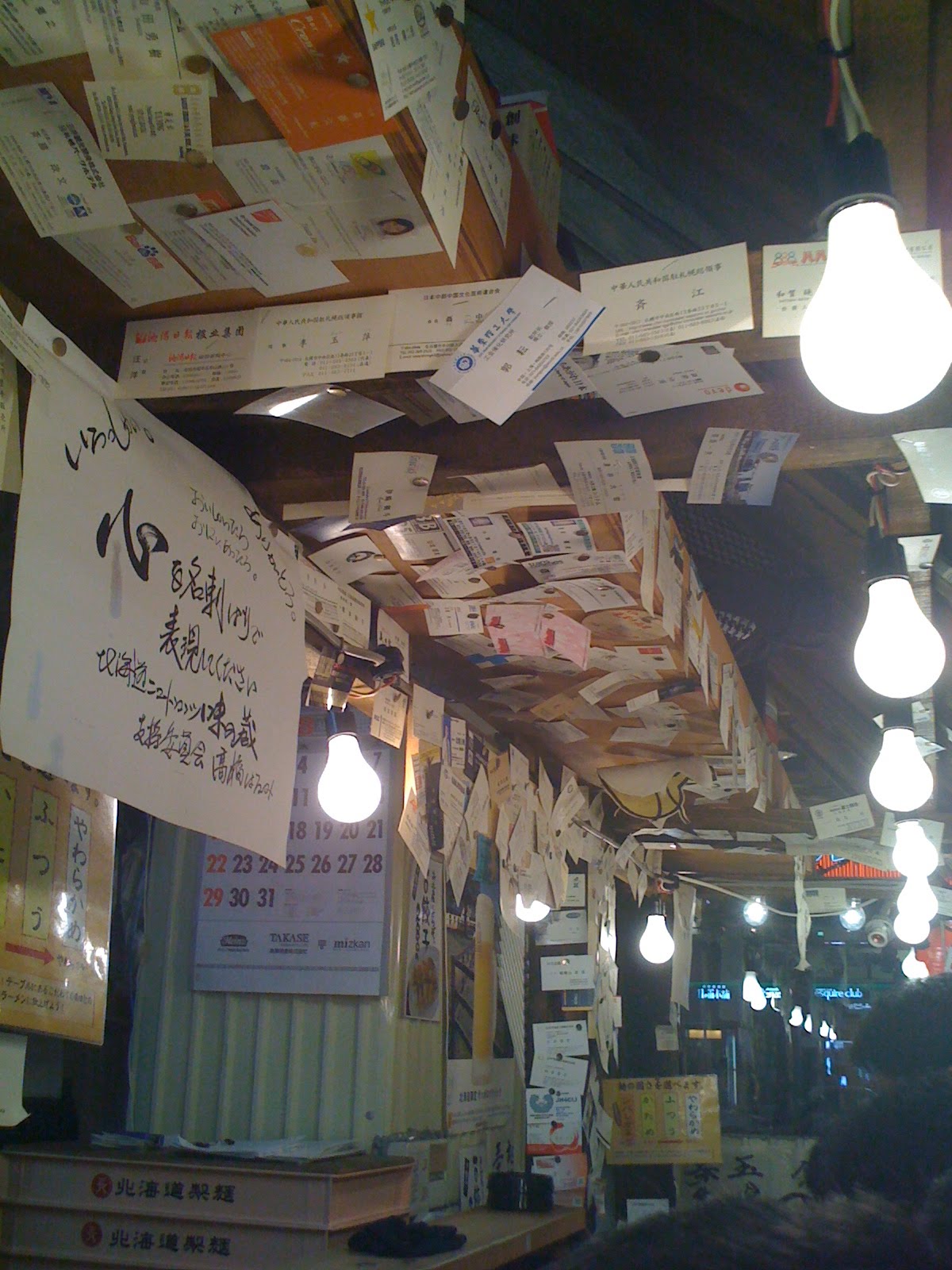
Despite my lack of knowledge of the shop, it seems immensely popular. Those writings on the ceiling are actually autographs typical of Japan, big thick cardboard like material that celebrities put their signatures on. Ookami Soup has them all the way to the ceiling.

I went with a friend (my ramen obsession has quickly spread amongst my circle of friends), and we arrived at 11 am, opening hours. Within 15 minutes the shop was full. At lunch. On a Tuesday.

This place is popular.

So let's examine the food. I ordered Miso with Egg.


First noting the color, it's a bit more orange than Sumire or Junren, which I liked.

The noodles are made by Nishiyama Noodle Company, the same company that makes noodles for Aji No Sanpei. So they are good, as expected, though we do love house made stuff more don't we?

I was worried however, about another Sumire/Junren knockoff. When you get labeled with that online, it means you resemble theirs at least to some degree.

However, I will say that Ookami managed to escape being a mere clone, and they do this through a very complex spice profile in the soup. Perhaps it's my palate that discerned this, but I honestly got hints of cinnamon and cardamom, with a slight hit of anise even. These rooty, musky spices are not as prominent, nor really used at all in the original, and so, at the very least, I have to applaud the store for actually pushing out of the box with some unique spices. It even had a little heat of chili flake.

But unfortunately, the majority of other characteristics are just not all that amazing. The egg is average, the noodles are good but not astounding, because they're factory made, the pork extremely tender but flavor wise normal, even the bamboo shoots are ordinary. I was extremely impressed with the soup for it's unique spice profile and interesting character, mellow yet complex, rich yet not overbearing, and not overly salty, but it just isn't enough when being compared to such legends in my opinion.

After all, Ookami Soup does have that label tacked on.

In good news, Ookami Soup does prevail in terms of location, as it is located just outside of Nakajima Park. For the tourist, Nakajima Park is a wonderful little escape from the city with a beautiful lake, trees, playground, and activities, and the location is accessible by a stop on the Nanboku subway line. You can rent a boat and paddle out to the lake, and afterwards, Ookami soup is right there to fill you up.

With that being said, if you plan on going to Nakajima Park, Ookami Soup is essentially a must visit for a quick, inexpensive, delicious lunch. But if going there is something out of the way, you might as well take the full trip down the Nanboku subway line to Junren or Sumire. They both exist down that way anyhow.


大きな地図で見る

Ookami Soup 狼スープ

Hours:
Mon-Fri: 11:00am-4:00pm
Sat-Sun: 11:00am-8:00pm
Closed Wedesday.

Links:
http://www.ohkami-soup.net/
http://ameblo.jp/ookami-soup/ (Shop's Blog)
http://r.tabelog.com/hokkaido/A0101/A010104/1000799/
http://amasan.livedoor.biz/archives/50895069.html

Ramen Sky, ラーメン空

Segueing fairly well from the concept of Yashoku Ramen and Miso as a historic concept within Sapporo, we have particularly one restaurant that stands out in context.

That restaurant is ラーメン空, or as I'll designate it, Ramen Sky.

Imagine a Sky made of Ramen, I would assume such a thing would be either incredibly frightening or awe inspiring.

I had quite a few sources direct me to this shop. It has a 3.5/5 rating on Tabelog, which despite what you may think, is surprisingly high, as even the highest rated Ramen shop only has around a 4/5 rating on the website. Furthermore, this shop also had a full page article in the book "Every Day Noodles", a guidebook highlighting different noodle shops across sapporo, including of course, Ramen.

However, most reviews online seem to suggest that it the restaurant's style is "Sumi Jun Ken", which as you remember, means it is essentially a replication of what Junren and Sumire have been doing for 40 something years. Thick soup, rich lard cap on top, golden noodles, you guys know.

This restaurant opened recently, and thus Yashoku has decided to collaborate with them, but the truth is that this restaurant had originally closed in 2006, to move to Nagoya, but after it actually came back to Sapporo. Interesting story in itself, it happens to have a particular cult following considering how new it is. Combining this with the amazing location near Susukino, the downtown party district of Sapporo, and you have a fairly packed restaurant.

Yashoku claims it is "a taste of Sapporo", which makes sense, it is after all, reminiscent of those Second Generation Ramen shops.


I sat down at the restaurant on a cool spring day,and the place was full up. Which brings me to my next rule.

3. A small ramen shop is usually a better shop.

There is just something about the size of a shop that makes the experience feel more personal. It also means the cooks have to be more intelligent and creative with space and ingredients, and food from smaller stores tends to be better.

But... this is a ramen review. How was it? Do I agree with the consensus?

For a bit of comparison, this is what Yashoku displays as their picture of the bowl.


And this is what I recieved


So, fairly accurate hm?
Well... I cannot tell a lie. It was certainly good.

But it wasn't amazing.

To be honest, knowing a little of the history of ramen now, I couldn't help but feel like it was merely ripping off Sumire and Junren. Nothing in particular stood out from the original rich miso ramen, maybe a little less in terms of the fat film floating on top. The noodles are not hand made, and as far as condiments go, your standard fair of sliced welsh onions, bamboo shoots, soft boiled egg, and roasted pork, known as "chashu". They were okay, nothing essentially standing out. Fresh ground ginger melted away in the soup for a little extra bite, which I liked but I couldn't shake the fact that I was eating essentially a remake of the second generation, with the only differences being that maybe a bit more tweak on the spice profile and a little less rich. Both Sumire and Junren also have ginger as part of the spice profile.

In this way, I can't say I agree with such a high rating online, because to me, the uniqueness of this bowl was extremely lacking. But I will not pretend like it was anything less than good. Remember the first rule after all :P

Therefore, in short, if you have the chance to go to the original "Sumi Jun Kei" shops, I would suggest skipping this place. For a bit of a twist, in a far superior and much easier to access location however, I would certainly recommend this shop.


View Larger Map

Ramen Sky ラーメン空
Hours: Tuesday-Saturday: 11 am-5 am
Sunday: 11 am to 1 am.
Closed Monday.


http://r.tabelog.com/hokkaido/A0101/A010103/1009044/
http://yashoku-ramen.jp/detail/detail.aspx?id=17657

Thursday, July 22, 2010

Aji no Sanpei 味の三平

About 4 years after Daruma-ken, the restaurant Aji no Sanpei was born onto the scene. In many ways, Aji no Sanpei is far more important, for it engraved essentially what is "Sapporo Ramen" into the world of culinary artistry. Aji no Sanpei invented Miso ramen.

Yes, invented it.

To clarify the importance of this achievement: when ramen comes to the mind of a Japanese person, they will almost indefinitely think of three basic categories in terms of flavor: shoyu, shio, and miso. These are ubiquitously called the "Three flavors", or 3味. The previous two have been discussed before, as the origins of ramen long before in Japan, but Miso is the newcomer of sorts, and Aji no Sanpei at the very least deserves high praise for inventing this whole new species of ramen.

I actually sat down with the owner of Aji no Sanpei, the contents of the interview can be found later on, and I'll link to it when I finish translating it.

Actually, in a bit of interesting lore, Aji no Sanpei buys noodles from the Nishiyama company, whom was created by the cousin of the owner of Daruma-ken. Everything has a connection in Japan I suppose.

Aji no Sanpei also has an old world feel to it, despite being located in perhaps the most perplexing and unique location I've come across for ramen shops: the 4th floor of a stationary store.


大きな地図で見る

Stationary and ramen... I have seen everything. But the idea makes sense; According to the owner, to avoid working late night hours, they decided to pick a shop that had a lot of traffic without being open through the middle of the night. This gave the shop owners somewhat of a life outside of the restaurant since it closed early, which, at least to the owners, was far more desirable than being open untill 2-3 am.

Miso Ramen actually was invented as a concept in pure post war idealism. People wanted food to be healthy, and bountiful, and full of calories and nutrition. Miso was successful because it had qualities that salt and soy sauce didn't, health and calories without extra cost. Perhaps this is why it took off initially.

The owner claims, like many, that his ramen has changed with the time, but I seem to believe otherwise; as do most restaurant visitors of Aji no Sanpei. Which makes sense, in comparison to Miso ramen today, Aji no Sanpei is far lighter, not rich or thick, and the miso flavor itself is surprisingly mild.

There is however, one specific issue. If you search 味の三平 (Aji no Sanpei) in google, one of the suggestions you get is this:

Look at the 3rd suggestion. まずい means literally "unappetizing", or as I like to think of it, "gross".

So... it seems like a fairly large number of people might be dissatisfied with Aji no Sanpei's ramen.

Perhaps we see a trend here, which leads me to the second rule.

2. A store's age is not correlated with it's quality.

A brand new store may have some seriously amazing eats, and an old store may have faded into it's obscurity and old history without evolving quickly with the times.

But how did I think of it? Did I agree with the 3.3/5 rating on Tabelog? Did I think it was "unappetizing"?


Well... I wouldn't go so far as to say that. Perhaps I am biased because the owner was so sincere and honest in my interview with him, so prideful and happy about his ramen and the history he and his family of cooks are responsible for. Perhaps it's because I have  a soft spot for miso ramen, and for cooks who genuinely love their food, their creations.

But... I kinda liked it. It has a very mellow, if almost unintelligible, miso flavor. The stir fried vegetables really show through, onion and bean sprout just the right texture, with stir fried minced pork added for a bit of richness. The pork base soup, which included boiled pig head (yes it's awesome) is murky and clouded and reminds me of a home cooked stock. The noodles are of course delicious and perfect in texture, and not just because they are made by an external company. I was allowed to visit them during preperation, speedy hands and silent maneuvers flawlessly enacting a dance like trance of slicing and boiling, and I saw how each of the 5 cooks for 15 minutes merely practices making the noodles to perfect accuracy.

"Ah... you're over 4 minutes now! Hurry up!" the owner shouted to one of the cooks as he prepared 7 orders of miso ramen simultaneously.

Still... this once again falls into the category of history over substance. Aji no Sanpei is lost in its old school character, and while this is charming, the quality of the ramen itself is good, but not astounding in comparison to ramen today. One should look at Aji no Sanpei for what it is, the origins of what we call "Sapporo Ramen", the first generation in a legacy of quality food.

For the history buff, this place is worth a look, of course. For the gastronomist, this place may be not.